
Traveling to Peru means entering a fascinating land, filled with memory, emotion, and ancient stories. It means crossing dizzying landscapes—from the Andes to the depths of the Amazon, through coastal deserts and high plains—and feeling at every step the presence of a people deeply rooted in their territory. Here, culture is not just heritage: it’s alive, lived daily, shared with pride and generosity. Before you go, take some time to learn a bit about the peruvian history and culture.
Long Before the Incas: A World of Ancient Civilizations
Before the mighty Inca Empire rose from Cusco to dominate the Andes, the land that is now Peru was home to a vast mosaic of ancient civilizations, each with its own systems of knowledge, social structures, beliefs, and artistic expressions. These cultures laid the foundations of Peru’s cultural richness and diversity, much of which still resonates today.
On the coast
On the northern coast, the Caral civilization (3000–1800 BCE) stands out as the oldest known civilization in the Americas. Caral developed large urban centers with pyramids, ceremonial plazas, and complex architecture—remarkably, without ceramics or written language. Their society was peaceful, centered around trade, music, and spiritual life, and marks the birth of organized Andean culture.
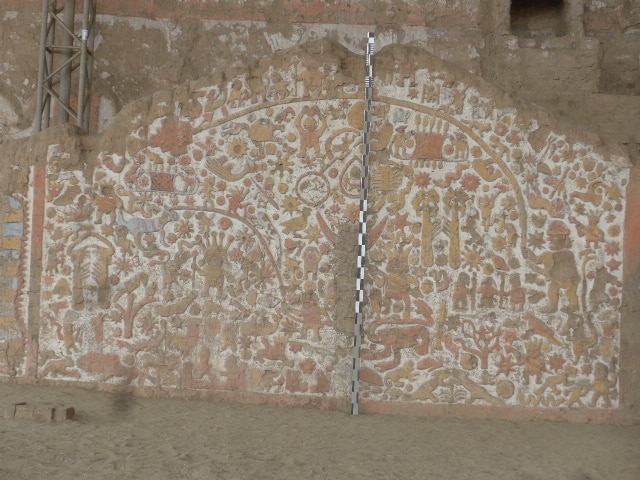
Centuries later, the Moche (100–700 CE) thrived in the same region, leaving behind extraordinary ceramic art and monumental temples such as the Huacas del Sol y de la Luna near Trujillo. The Moche were highly stratified, with elite classes and elaborate rituals—some involving human sacrifice—deeply tied to agriculture, nature cycles, and war. Their art, often erotic or violent, gives us an unparalleled glimpse into their worldview.

Further north, the Lambayeque (also known as Sicán, c. 700–1375 CE) are remembered for their mastery of metallurgy. They produced intricate gold funeral masks and ornaments, as seen in the spectacular tomb of the Lord of Sipán, one of the most important archaeological discoveries in South America.
On the arid southern coast, the Nazca (100 BCE – 800 CE) etched gigantic geoglyphs into the desert—the Nazca Lines—depicting hummingbirds, monkeys, and geometric shapes only visible from the air. Their purpose remains a mystery, sparking theories from astronomy to ritual pathways. But beyond their art, the Nazca also excelled in hydraulic engineering, building underground aqueducts (puquios) to irrigate their fields.
In the peruvian Andes
In the southern Andes, around Lake Titicaca, the Tiwanaku culture (c. 400–1000 CE) developed a spiritually oriented and agriculturally advanced society. Their massive stone constructions and astronomical precision suggest deep cosmological understanding, and their influence spread widely across the highland plateau.
In central Peru, the Wari (600–1000 CE) built one of the first Andean empires, preceding the Incas by centuries. They established administrative centers, created planned cities, and developed a vast road system. Their political and social innovations would later be adapted and expanded by the Inca state.
Several other civilizations played essential roles in shaping Peru’s early history:
-
The Chavín (900–200 BCE), a highland culture centered on Chavín de Huántar, created a unifying religious cult that spread across much of the Andes. Their art—featuring jaguars, serpents, and supernatural beings—was deeply symbolic and influenced later iconography.
-
The Recuay (200 BCE – 600 CE), based in the highlands near Huaraz, were known for their sculpted stone figures and defensive hilltop settlements.
-
The Chachapoya, or “Cloud People,” flourished in the cloud forests of northern Peru. Builders of the mountaintop citadel of Kuélap, they excelled in terraced agriculture and left a legacy still present in the traditions of the Amazonas region today.
These pre-Inca civilizations did not simply rise and fall in isolation. They interacted, influenced one another, and contributed to an evolving Andean cultural landscape. What emerges is a dynamic, multilayered history, marked by creativity, innovation, and deep ties to nature and the cosmos.
Centuries later, the Incas would synthesize and organize many of these legacies into a powerful empire. But it is important to remember that Peru’s history did not begin with the Incas—and that the stories of these ancient peoples still live on, carved into temples, woven into textiles, and remembered in the rituals of today’s Andean communities.
The Inca Empire: Glory and Tragedy
In the 15th century, the Incas—a small group from the Cusco region—rose to power, forever changing the course of Peruvian history. In less than a century, they built the largest empire in pre-Columbian America: the Tawantinsuyu, stretching from present-day Colombia to northern Chile, and from the Amazon rainforest to the Pacific coast.
Their genius lay in both political organization and the ability to integrate conquered peoples. The Incas made Quechua the administrative language, developed an exceptional network of roads (the famous Inca Trails), and structured their empire around a worldview deeply connected to nature and the cosmos. Respect for Pachamama, the Earth Mother, was central to their spirituality.
But this greatness came to a sudden end in 1532, with the arrival of the Spanish conquistadors. Taking advantage of internal conflicts and the shock of firearms, Francisco Pizarro and his men brought down the empire with the capture of Emperor Atahualpa. Peru’s history then entered a new era, marked by rupture, cultural blending, resistance, and rebirth.
A Multicultural and Resilient People
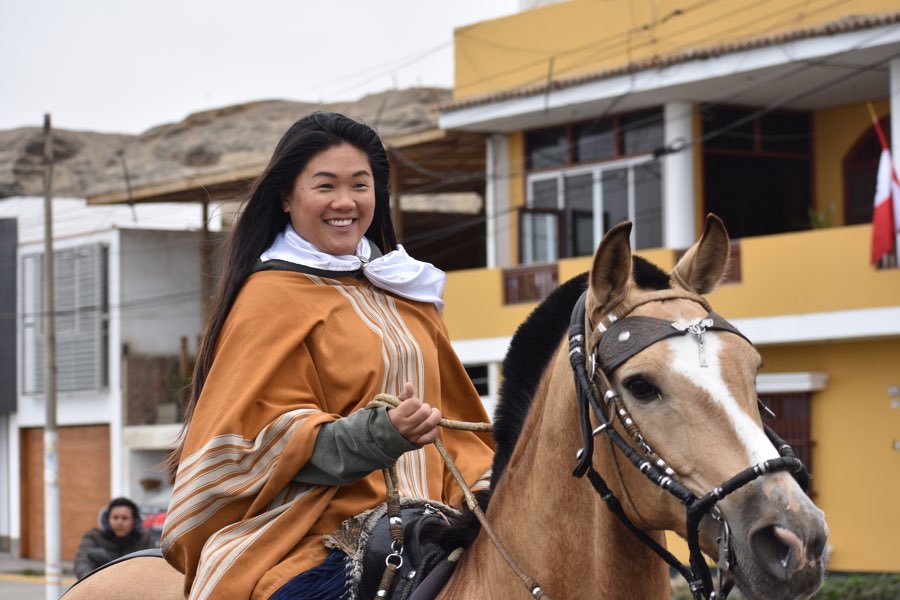
Today, Peru is proud of its diverse roots. Quechua, Aymara, Afro-Peruvians, Mestizos, Amazonian communities—the country is home to a rich tapestry of cultures, each contributing to the nation’s traditions, cuisine, music, and festivals.
In the Andes, pre-Columbian traditions coexist with colonial influences. Folkloric dances, handwoven colorful garments, and celebrations like the Virgen de la Candelaria in Puno or the Inti Raymi in Cusco illustrate a unique blend of Andean spirituality and Catholicism.

The Quechua language, long marginalized, is experiencing a revival, fueled by a renewed pride in cultural identity. In rural areas, ancestral knowledge—on agriculture, herbal medicine, and lunar calendars—is still passed down orally through generations.
In the cities, a creative and urban youth is reinventing Peruvian history and culture, blending roots with modernity. Fusion music, graphic arts, independent cinema, and contemporary cuisine show that Lima and other Andean cities pulse with a cultural energy deeply connected to tradition.
A Culture to Be Lived, Not Just Visited
At Phima Voyages, we believe that a truly meaningful journey in Peru begins with meeting its people—listening to their stories, learning their knowledge, and observing their daily lives.
It’s by sharing a meal in an Andean community, listening to a legend by the fire, or watching a craftsperson weave traditional patterns, that one truly begins to understand the richness of this country.
Peru is not defined solely by its archaeological wonders—no matter how awe-inspiring they are. It is experienced in the moment, through smiles, rituals, vibrant markets, and landscapes steeped in memory.