Why We Measure the Carbon Footprint of Our Trips: Transparency, Findings, and Actions for 2026
At Phima Voyages, we have always championed a vision of tourism that makes sense: tourism rooted in reconnection, human connection, and respect for the local communities and environments that welcome us. However, to sustainably preserve the destinations that inspire us, goodwill is no longer enough. We need data, rigor, and a genuine commitment to accountability.
That is why I wanted to involve Phima Voyages in a structured and demanding process: completing a comprehensive Carbon Footprint assessment of our 2025 client trips.
To successfully carry out this complex task, I called upon the expertise of Marius BERNARD-HERVÉ. Marius is a Travelife Coach and sustainable tourism consultant. Together, we meticulously analyzed every single travel booking to understand the real impact of our trips.
Today, I want to share the results of this evaluation with you. You will see what it implies for the way you travel, and the concrete actions we are implementing right now for 2026.
Our Internal Operations: An Already “Clean” Structure
Before discussing the trips themselves, a brief word on how we operate. Our team is located in different parts of the world (France, Peru, Argentina). We work remotely on a daily basis to design your tailor-made itineraries. Our own operational impact (Scope 1 and Scope 2) is extremely low, if not neutral. We have no daily commutes to an office, and the energy we use at home year-round would be consumed regardless of whether we were working or not. Therefore, our offices emit almost nothing.
We do not print documents because we work entirely online (an assessment of our digital footprint is planned for next year). Our true Corporate Social Responsibility (CSR) and our primary lever for action lie elsewhere: directly within the trips we design for you.
The Major Finding: The Reality of the Carbon Weight of a Trip to Peru
Thanks to the methodology validated by Marius—based on assessing the flight portion per booking, to which we apply a peer-accepted flat-rate increase of 10% to cover all ground impacts (hotels, transfers, trains, excursions)—the figures speak for themselves.
In 2025, we recorded 150 travelers, representing a global emission of 722 tonnes of CO2 equivalent (tCO2e). This brings the average to 4.8 tonnes of CO2 per traveler. (We did not include travelers who were already present in Peru).
4.8 Tonnes of CO2: What Does That Represent?
To give you a concrete sense of scale, 4.8 tonnes of CO2 is equivalent to:
-
The entire annual carbon footprint of a French citizen who is already making significant efforts toward sobriety (whereas the Paris Agreement target is 2 tonnes per year per person by 2050).
-
More than 24,000 kilometers driven in a standard internal combustion engine car.
-
The manufacturing and life cycle of nearly 150 smartphones.
The International Flight: Incompressible
What is fundamental to understand as a traveler is that almost the entirety of this footprint is linked to the international flight—for instance, a Paris-Lima flight. Flights departing from Germany are even more carbon-intensive because they are not direct and transit through Madrid, Paris, or Amsterdam. The long-haul journey alone accounts for nearly 90% of the total carbon footprint of your stay.
Once at the destination, the ground impact is minimal. What can significantly tip the scales in Peru are domestic (internal) flights. Adding one or two domestic flights to connect Lima with Arequipa and Cusco adds weight to a carbon bill that is already very high.
Tools for Action
This carbon footprint assessment is not just a passive observation. The precise data collected by Marius will help us steer our low-carbon strategy for the coming years by creating accurate environmental indicators.
As a travel agency, we can advise and raise awareness among our clients at the time of booking so that their trip emits as little carbon as possible, by leveraging several strategies:
-
Choosing airlines with modern, recent fleets.
-
Proposing direct flights whenever possible.
-
Avoiding certain domestic flights by prioritizing high-quality ground travel by train or bus when comfort permits.
-
Extending the duration of stays to lower the carbon intensity of the trip: “Travel less often, but stay longer.”
Your Trips: What Do 5 Tonnes of CO2 Look Like in Practice?
Since tailor-made travel is in Phima Voyages’ DNA, every booking is unique. It is difficult to establish a standardized itinerary per destination. However, to give you clear visibility, we have selected two typical travel itineraries. You will see that they hover around our pivotal average of 4.8 tonnes of CO2 per traveler.
First Example: The Classic Grand Northern Tour
This trip includes your international flight (such as Paris-Lima) and a single domestic flight to return from the north to Lima at the end of the stay. Naturally, it also includes your entire itinerary on-site completed by land (scheduled buses, collective or private transfers). For this type of stay, the estimated footprint is the lowest, at approximately 4.6 tonnes of CO2 per traveler.
Second Example: Total Immersion North & South Peru (with internal flights)
This highly comprehensive itinerary is designed for travelers wishing to optimize their time by combining the two main regions of the country. It includes the international flight as well as 4 domestic flights. Unfortunately, even with 4 weeks of travel, connecting key stages quickly requires flying—for example, starting in Trujillo, ending in Chachapoyas, flying to Arequipa, and returning from Cusco. With this significant flight configuration, the footprint rises to approximately 5.2 tonnes of CO2 per traveler.
Our Climate Solidarity Action: Supporting the Milpuj PCA
Once the itinerary has been optimized and everything that could be reduced has been addressed, there remain so-called incompressible emissions. The long-haul flight to get there remains mandatory. To take responsibility for this impact, a Carbon Contribution is indispensable.
But at Phima Voyages, our vision of tourism drives us to reject the greenwashing of industrial or anonymous offsetting projects. I do not want to simply buy carbon credits to plant trees on the other side of the world without knowing if they will grow. I believe in transparent, field-based, and collaborative environmental support.
On the market, the cost of absorbing one tonne of CO2 is generally estimated at around 10 Euros. Based on our evaluation of 5 tonnes per traveler, this corresponds to a contribution of 50 Euros per person.
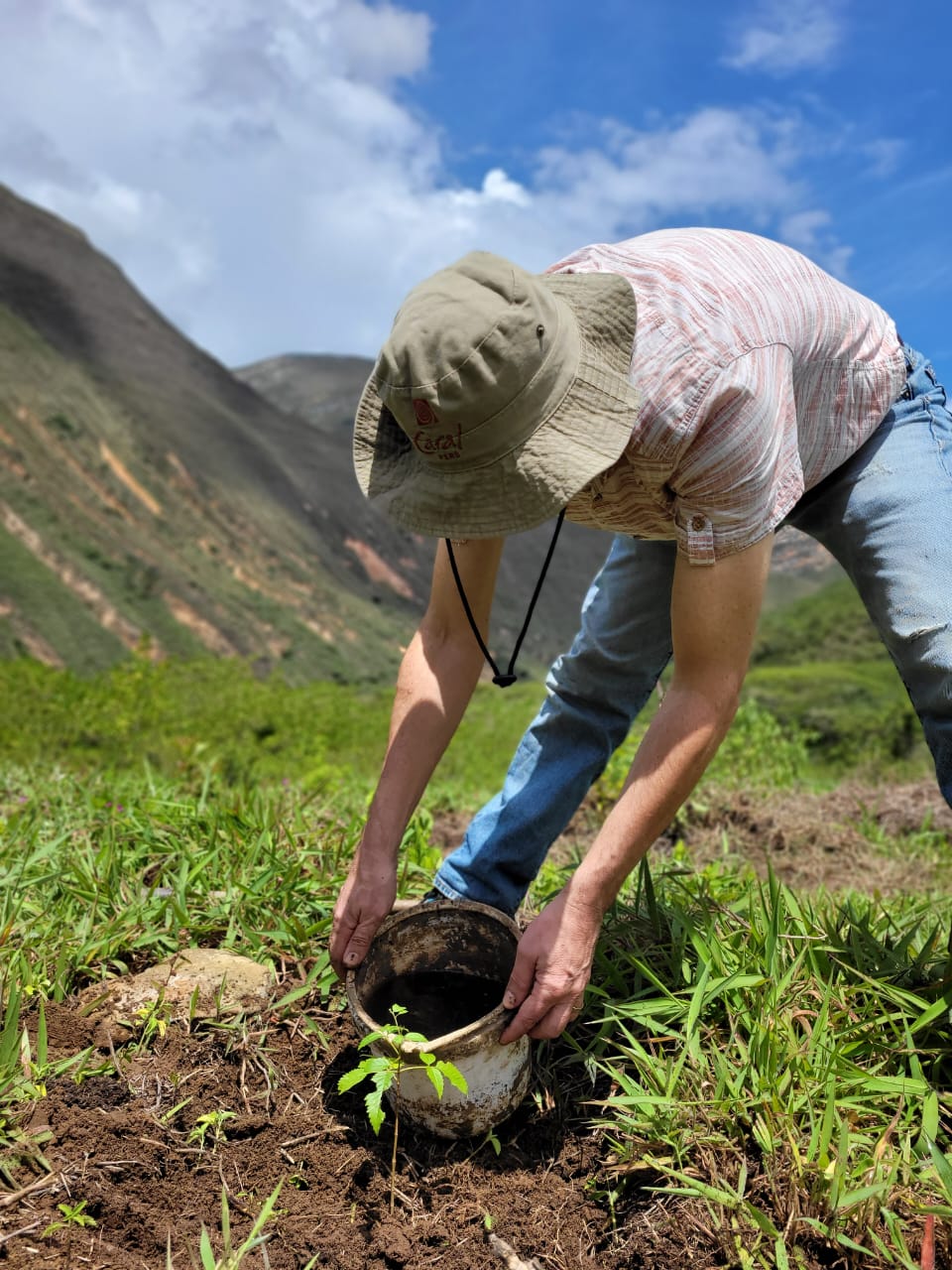
At Phima Voyages, we have chosen to allocate 100% of these contributions to a local project. We personally know the owner, Perico, in whom I have absolute trust: the Milpuj PCA (Private Conservation Area), located in northern Peru.
Who is Perico and What Does the Milpuj PCA Do?
The Milpuj PCA is an extraordinary family project nestled in the Utcubamba River valley, passionately managed by Perico (Pedro Heredia).
His mission? To protect and restore the Amazonian dry forest, a highly threatened ecosystem. In doing so, he reintroduces local wildlife (such as the spectacled bear or the marvelous spatuletail hummingbird) and preserves endemic trees like the tara tree. Perico does not just plant trees; he protects a living habitat, educates local communities, and creates a sanctuary for biodiversity.
(You can find his full story and our joint actions on our dedicated Milpuj page).
Right Now: Let’s Prepare the 2026 Trips Together
We are not waiting for future assessments to take action. Starting today, when you book your trip for 2026, we are integrating this climate solidarity approach.
On your proposals and quotes, you will now find a small optional checkbox allowing you to contribute €50 per traveler. Of course, this amount is indicative. Every traveler remains free to give the amount they wish, and any support for this project is welcome. The entirety of this donation will be paid directly to Perico to finance the protection of the Milpuj forest. Phima Voyages naturally takes zero commission on this amount. It is a direct commitment from you, the traveler, to the land that welcomes you.
Thank you for being part of this more conscious, more transparent journey, resolutely committed by our side.